Living On, Borderlines: Hypermodernity and the domicile of the Other
Housing the self and the other - Housing the self as the other: The Tourist Edition
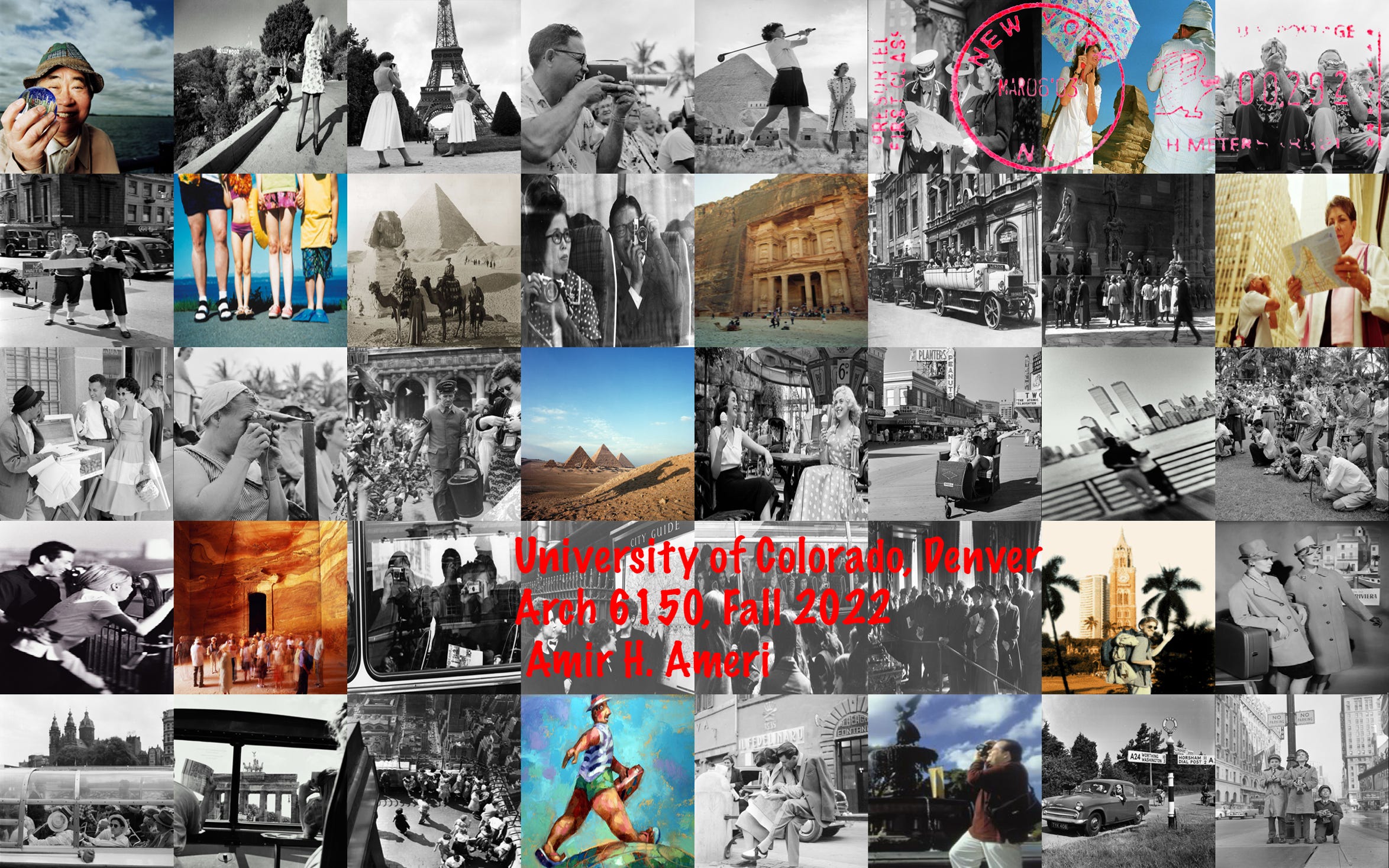
One of the most significant and enduring cultural legacies of Modernity is the ritual of tourism. As an integral part of the post-industrial culture, the tourist industry is, by some accounts, the largest industry in the globe. It is not easy to find a city or locality in the modern world that does not construe and present itself to the outside world as a tourist destination. It is equally difficult to find a modern subject that does not aspire to participate in the ritual of tourism at its inexhaustible destinations. Having traveled the world in quest of the authentic experience of other localities and cultures has long been a barometer, not only of Modernity but also of cultivation, cultural status, and class distinction in the modern world.
Integral as the institution of tourism is to the post-industrial culture, the ritual of tourism is, nevertheless, riddled with complexities and contradictions. Much as touring and seeing the world–construed as it is by modern culture as a collection of tourist destinations–may be desirable and desired, doing so as a "tourist" attracts nothing but scorn and contempt. To be a good tourist is first and foremost not to appear or come across as a "tourist," i.e., not to do what "tourists" do while doing it. Much as the tourist and tourism's objective is the authentic experience of other cultures and places, the "tourist" is, nonetheless, the synonym of inauthenticity and paltriness. Culler notes that:
tourism has so few defenders, constitutes an embarrassment, and seems such an easy target for those who would attack modern culture. The tourist, it seems, is the lowest of the low. No other group has such a uniformly bad press. Tourists are continually subject to sneers and have no anti-defamation league. Animal imagery seems their inevitable lot: they are said to move in droves, herds, swarms, or flocks; they are as mindless and docile as sheep but as annoying as a plague of insects when they descend upon a spot they have 'discovered.'
Keeping in mind that architecture has been, from the outset, an essential, complacent, and integral part of the tourist industry–serving to both attract the tourists (monuments and museums) and circumscribe them (hotels and hostels)–the complexities and contradictions of tourism and its ramifications for architecture will be the focus of our design investigations for this term. Tourism will serve us as a vehicle for exploring the complexities of the dialogue between architecture and the culture industry. The premise guiding this exploration is that edifices are, intended or not, ideological constructs that express ideas and reaffirm and reinforce or else critically engage the values, beliefs, ideas, and ideals of the culture they serve. Some of the issues we will explore in this studio are how theses are formed and given architectonic form and what specific role buildings do or can play within the broader cultural context.
The objective is for you to develop, based on the above analysis and critical evaluations, an analytical stance and a distinct agenda (idea, concept, intent, etc.) that will allow you to formulate specific formal strategies for the design of a mid to high rise building, comprised of two domiciles: a hotel and a residence. On the whole, the building should speak to and vividly address the complexities and contradictions of tourism.
The pedagogical intent of this design exercise is twofold. The goal is to foster and develop the analytical skills essential to deciphering the complex relationship between architecture and the culture industry it perpetually serves, i.e., the skills essential to the formation and evaluation of design ideas and programs. It is also the goal of this exercise to promote a conscious reevaluation of all the subconscious assumptions regarding the spatial organization, the relationship of parts to the whole, the inside to the outside, the particulars of volume and mass, solid and void, path and place, structure and material, ornamentation, proportion, scale, and others. This is with the intention of designing an environment that silently speaks of the designer's ability to willfully manipulate the language of architecture by way of expressing a well-researched, informed, and analytically rigorous stance.
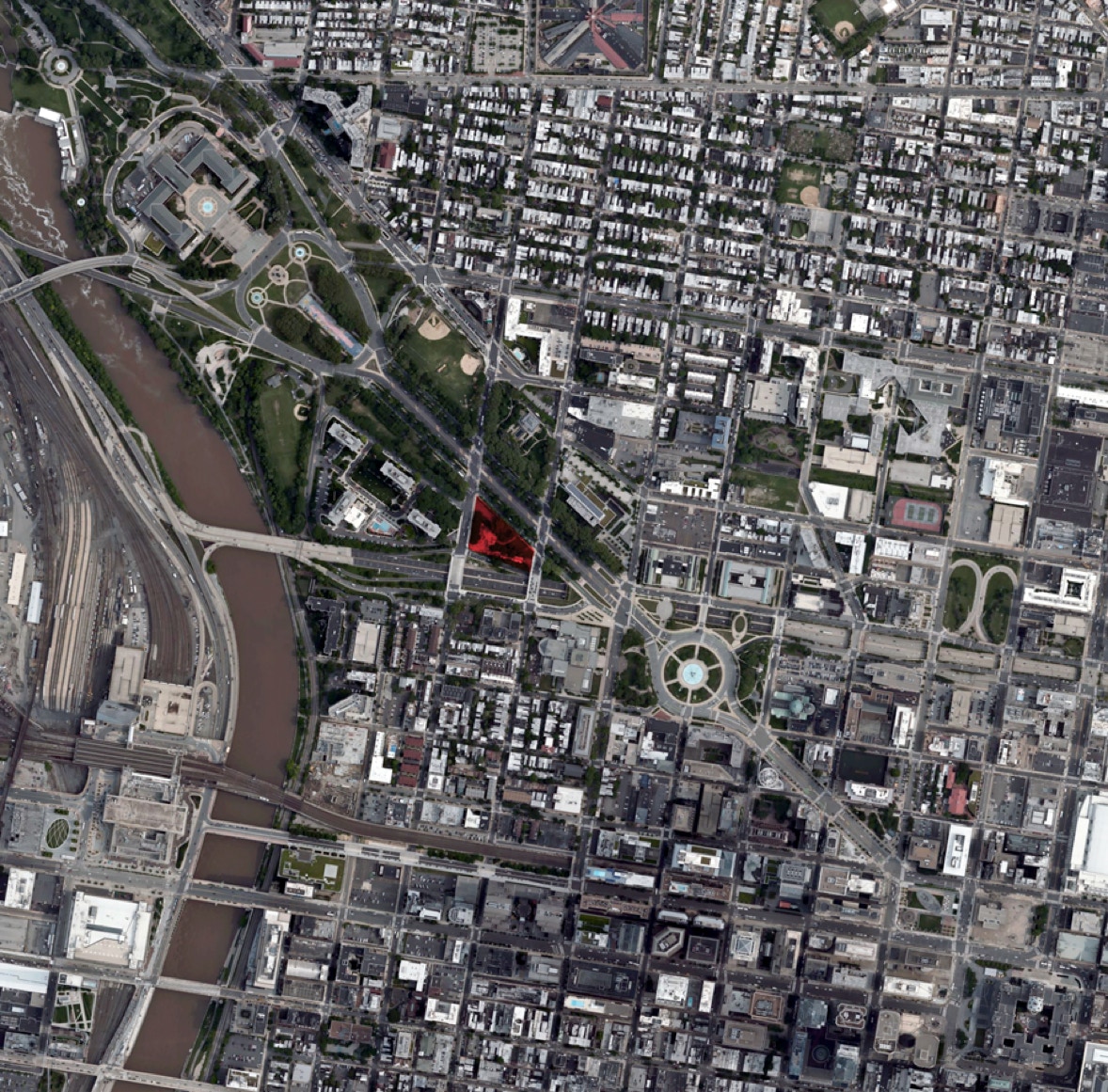
The question of tourism is inextricably tied to site and sight, to place and placement (insider vs. outsider, onlooker vs. participant, local vs. alien, etc.). We will, therefore, pay particular attention to the act of sitting and the inevitable dialogue of building and site or rather intention and contextualization, reading and context. The actual site for the project will be one of two sites on Benjamin Franklin Parkway in the city of Philadelphia.
You should develop a specific program for your building based on your research and analytical stance.
We will keep to the following schedule, and you must submit the required documents by the specified dates as follows :
I. Building/Institutional analysis August 23 - September 9
II. Spatial studies and explorations reflecting the above analysis August 26 - September 9
III. Statement of Intent September 9
IV. Site/Context analysis September 13-16
V. Programmatic response to all of the above September 16-23
VI. Design(ed) reflections September 23-November 29
VII. Presentation Proposal November 18
VIII. Final Presentation December 9, 1-5 PM
IX. Portfolio December 16
The final presentation will be treated as a design problem in its own right. You are encouraged to explore the limits of the conventions that pertain to architectural presentation and thereby design a presentation that effectively communicates the issues grappled with throughout the term. The final presentation should include the conventional plan, sectional drawings, and a detailed model as a point of departure.
As an extension of the final presentation, you are required to submit a portfolio of your work by December 16. Your portfolio should document your ideas, your progress through the term, and the final project. The portfolio should be submitted as a PDF document for high-resolution print along with all the related images in JPG format (maximum quality, 300 dpi minimum). These should be submitted through OneDrive or any similar web sharing app.
In the first half of the term, much of the studio time will be devoted to group discussions and collective review and analysis of individual work. We will devote more time to individual reviews and discussions in the second half of the term.
Your performance in class will be evaluated based on active participation in group discussions and reviews, vigorous exploration of the issues at hand, as well as analytical rigor and willful manipulation of the language of architecture as opposed to formal reiteration in the absence of a thorough comprehension of all the incumbent issues. The ultimate criterion is the successful completion and presentation of a project that realizes a coherent and rigorous thesis based on a comprehensive analysis of the nature of the assigned problem. For a detailed description of the studio outcomes and evaluative criteria, please see the Studio Outcomes document.
Required Reading
Edmund Leach, Claude Lévi-Strauss, New York: Penguin Books, 1974
Oysters, Smoked Salmon, and Stilton Cheese, pp. 15-33
Amir H. Ameri, The Architecture of the Illusive Distance, Farnham: Ashgate Publications, 2015
Introduction, pp.1-9
Judith Butler, The Judith Butler Reader, Sara Salih Ed. Blackwell, Malden, 2004
Bodily Inscriptions, Performative Subversion, pp. 103-115
Dean MacCannell, The Tourist: A New Theory of the Leisure Class, Berkely: University of California Press, 1999
pp.1-16, 39-56, 91-160
Georges Van Den Abbeele, Sightseers: The Tourist as Theorist, Diacritics, Vol. 10, John Hopkins University Press, 1980
pp. 2-14
Jonathan Culler, Framing The Sign: Criticism and Its Institutions, Norman: University of Oklahoma Press, 1988
The Semiotics of Tourism, pp.153-167
Jacques Derrida, Of Hospitality. Trans. Rachel Bowlby. Stanford: Stanford University Press, 2000
Recommended Reading
William Baker, et al. Grand Hotel: Redesigning Modern Life. Ostfildern: Hatje Cantz, 2013.
Dean MacCannell, The Ethics of Sightseeing. Berkeley: University of California Press, 2011
Marc Auge, Non-Places: An Introduction to Supermodernity. Trans. John Howe. New York: Verso, 2009
Sharon Bohn Gmelch, Tourists and Tourism: A Reader. Long Grove: Waveland Press, 2009
Andrew K. Sandoval-Strausz, Hotel: An American History. New Haven: Yale University Press, 2008
Claudio Minca and Tim Oakes, Ed., Travels in Paradox: Remapping Tourism, Lanham: Rowman & Littlefield, 2006
Joan Ockman and Salomon Frausto, Ed., Architourism: Authentic, Escapist, Exotic, Spectacular, Munich: Prestel, 2005
Edward M. Bruner, Culture on Tour: Ethnographies of Travel. Chicago: University Of Chicago Press, 2004
Sharon Bohn Gmelch, Ed., Tourists and Tourism: A Reader, Long Grove: Waveland Press, 2004
D. Medina Lasansky and Brian McLaren, Ed., Architecture and Tourism: Perception, Performance and Place, Oxford: Berg, 2004
Erve Chambers, Native tours: the anthropology of travel and tourism, Prospect Heights: Waveland Press, 2000
Elaine Denby, Grand Hotels: Reality and Illusion. London: Reaktion Books, 1998
Barbara Kirshenblatt-Gimblett, Destination Culture: Tourism, Museums, and Heritage, Berkeley: University of California Press, 1998
Dean MacCannell, Empty meeting grounds: the tourist papers, New York: Routledge, 1992
Louis Marin, Utopics: the semiological play of textual spaces, Atlantic Highlands: Humanities Press International, 1990
John Urry, The Tourist Gaze: leisure and travel in contemporary societies, London: Sage Publications, 1990
Valene L. Smith, editor, Hosts and guests: the anthropology of tourism, Philadelphia: University of Pennsylvania Press,1989
Eco, Umberto, Travels in hyperreality, William Weaver, Trans., San Diego: Harcourt Brace Jovanovich, 1986
Roland Barthes, The Eiffel Tower and Other Mythologies, New York: Hill & Wang, 1979. The Eiffel Tower, pp.3-17
Walter Benjamin, Illuminations, New York: Schocken Books, 1978. The Work of Art in the Age of Mechanical Reproduction, pp. 217-252
Tourist Questions
What is the relationship between tourism and authenticity?
Why do tourists seek authentic objects and experiences?
What is the draw of the authentic?
What is the relationship between authenticity and markers?
What does Culler mean by authentic being "a sign of itself"? (p.167)
Why do tourists seek authenticity at a distance, i.e., there, away from "home?"
What is the relationship between tourists and intellectuals?
What is the relationship between "home" and tourist sites?
What is site-seeing, i.e., its mechanism, mode of looking, recognition, marking, etc.?
Why do tourists avoid tourists?
Why is a good tourist site considered to be one without other tourists?
Why is tourism denigrated/trivialized?
Why are tourists criticized for their inauthenticity, shallowness, etc.?
What are the tell-tale signs of the tourist?
What is the relationship between Modernity and authenticity? (1p.3)
What is Modernity beyond its outward trappings, i.e., at the structural level? (1p.7-8)
MacCannell claims that tourist shame is internal to the enterprise, that all tourists wish not to be tourists, i.e., to experience things authentically. Why? Explain. (1p.10)
What is the process of site marking (Framing)? (1p.44-5)
What does MacCannell mean by "Tourist attractions are signs?"
Place, Sight, Authenticity
Where / What is the place of tourism?
What place do tourists have? Where do they fit? How does one center the tourist, or what amounts to the same, give center to tourism? Where is the periphery against which the center is measured? Can one center the tourist?
What are the ramifications of the tourist label for the (dis)placement of the labeled?
Where does the label locate the labeled?
Is there a relationship between tourism and thresholds?
What are/could be the characteristics of a space that belongs to tourists, i.e., their space/place, as opposed to places/spaces they visit?
What central themes in tourism can we identify that have an architectural bearing and significance, e.g., threshold, temporality, displacement, ...
Context.Building
How should the Tourist Hotel read?
Should it be a home away from home?
Should it be a tourist site?
Should its imagery, in other words, be domestic or monumental?
Should it be directed to or read as belonging to the tourists (outsiders) or the city (locals)? (siting ramifications)
Should it shelter, or should it display? Hold within or project out?
Should it have a sense of permanence or be transitory? Secure or insecure? A place to arrive at or a path to go through?
What are the guiding ideas in the decision-making process above?
How should the Tourist Hotel relate to the site?
How should it relate to the site boundaries?
Should it read as though it is inside or outside those boundaries, e.g., coming into or leaving the site?
Should it be in/within or projecting out?
Should it merge into or stand out from its context?
Should it sit on, emerge from or submerge into the ground plane?
All of the above?
Should the building be static or dynamic in composition? Concentric or the opposite? Gather itself in or explode out?
Should it be holistic or fragmented, one or several?
Should it be linear or circular? Why?
How do any of these decisions relate to the tourist experience?
What do you wish to say about Tourism and the tourist experience with your Tourist Hotel? What is your stance/interpretation based on your research?
Tourist in City Presentation
Construct a virtual tourist experience of your city. Please visually address the following questions:
Why do tourists go to this city?
What are they supposed to see there?
What are they supposed to experience there?
How do they see/experience this city?
Tourist Hotel / Native Residence
To clarify the objectives and prepare for an effective presentation of your intent and approach, please provide a concise response to the following questions:
1. Of the complexities and contradictions in the tourist ritual, which interests you most, i.e., which have you chosen as your focus? [The tourist gaze in relation to the tourist desire (distance), the relationship of sights and markers (framing), the relationship of the path to its objective (marginalization), the enigmatic place and role of tourists where they happen to be, etc. Provide a concise explanation of what the complexity or the contradiction is. Be very specific.
2. Discuss what bearing the above focus can/does have on the design of a tourist hotel? How does it affect the design? What issues does it raise that you, as a designer, will have to address? What design strategy(ies) have you adopted/propose by way of addressing the issues raised?
3. Provide a written and a graphic explanation/documentation of your reading/interpretation of the site. What is unique and distinct about this site? How does it work as a composition? In other words, what specific and unique relationship exist between the various elements that constitute the site. Provide graphic documentation of every interpretation.
4. What specific challenges the site, in its specificity, present to the design of a tourist hotel that is trying to address the complexity/contradiction you have focused on and explored? What specific questions does the site raise? How do you propose to answer them? In other words, what specific dialogue do you propose between your design and its context?
SITE
Studio Outcomes and Assessment
Objectives
The pedagogical intent of this studio is twofold. The goal is to foster and develop the type of analytical skills essential to deciphering the complex relationship between architecture and the culture industry it perpetually serves, i.e., the skills essential to the formation and evaluation of design ideas and programs. It is also the goal to promote a conscious reevaluation of all the subconscious assumptions regarding spatial organization, the relationship of parts to whole, the inside to the outside, the particulars of volume and mass, solid and void, path and place, structure and material, ornamentation, proportion, scale, and others. This is with the intention of designing a building that silently speaks of the designer's ability to willfully manipulate the language of architecture by way of expressing a well researched, informed and analytically rigorous stance.
Outcomes
Given that architecture is necessarily and always a theoretical construct, a form of speech, or a cultural “myth” in the making, that every edifice inevitably speaks of a thesis regarding itself specifically (including the cultural conditions of its conception and production) and architecture broadly (including the cultural conditions of architecture’s conception and definition), students are required at outset of the studio to ask, research, and analyze not what patent ‘theory’ or idea should the assigned building speak of, but what arcane theory does its type historically hide under the rubrics of “function” or “practical” requirements? What myth, in other words, does the type refuse to acknowledge as theory in the name of practicality? To find an answer students are required to do extensive guided research in order to reconstruct the genealogy of the building type under investigation - the genealogy of forms inseparable from the genealogy of the institution served. They are required to critically analyze and decipher the formal/architectural framing process by which the given institution turns its theory/ideology into myths and passes them on as functional and practical givens. They are required to analyze and critically evaluate the historic role the type plays in establishing and effecting a given institutional/social order as the natural, and practical order of things.
The pedagogical aim of this investigation is neither to simply accept and promote a given theorem/myth nor to assume the luxury of rejecting it in favor of a different theorem/myth. Though one may choose to follow either route, it is essential to first understand what it is that one is opting to defend or supplant. From a pedagogical standpoint, the defense in either case cannot be or rather should not be blind, i.e., conducted expeditiously and unknowingly under the guise of functionality and/or practicality.
Before any question of choice, it is essential to decipher and understand the mechanics of the
particular and complex dialogue between form, function and ideology in the subject of study. To prevent the students from mere repetition - a strategy that is pedagogically unsound, in as much as it is not readily assessed whether or not the students have actually understood the theoretical complexities of the assigned building problem and are capable of willful manipulation of the language of architecture as opposed to repetition of its individual speech acts - students are asked not to promote the given institutional myth, i.e., cease to frame and present the myth as a natural given, or what is not fundamentally different, supplant the myth with another presented in the same guise. They are asked not to affirm but question, not to engage but to disarm. They are asked not to pose but to expose. In sum, they are asked to design a building that exposes the arcane theory of the type as myth (history), in place of disguising it as nature. They are asked to design a building that is at once familiar and alien, old and new. To this end, students are required to develop a distinct building program that encompasses their research and critical analysis of the building-type under investigation.
In turn, student are required to start their design process by analyzing and understanding the dual nature of each architectural element as both a function and an expression, i.e., in terms of what each does and what each says or is capable of expressing. They are given design exercises that require them to distinguish and explore how architecture communicates both statically and dynamically, in space and in time, i.e., passive and active reception. They are asked to distinguish between experiencing architecture, which is accumulative, and viewing it, which is totalizing as a mode of reception. They are asked to recognize and shape space as the fundamental experiential element of architecture as well as how to use form as a means to shaping space as opposed to an end in itself.
The above exercises are meant to prepare students for the translation and transformation of their thesis into a formal architectural strategy with a clear understanding of reading being context dependent and architectural expression being a question of relational composition at every scale, that no element, in itself, communicates anything. Also, architectural expressions are fundamentally experiential and evanescent and not concrete or verbal.
Students should come away from the initial design exercises with a clear understanding of the crucial interplay between analysis and design as two complementary processes. They should understand analysis as a process of moving from realization to abstraction (e.g., from form to principle, to intent) and design as a process of going from abstraction to realization (e.g., from intent to form). To this end, students are required to begin their design with site/context analysis understood as a process of moving from realization to abstraction, develop an abstract diagram that encapsulates their intent in response to the specifics of the site/context, and proceed from the abstract diagram to the full realization of their intent in programmatic form and space.
This process is intended to develop greater appreciation for compositional hierarchies leading to detail, i.e., understanding the role of primary, secondary and tertiary elements of the composition and clarification of intent in each subsequent layer of the hierarchy, i.e., how what is intended in one layer is clarified by the secondary layer of articulation, and so on down the line. It is also intended to develop greater appreciation for experiential progression and the significance of relationships.
Culture, it is important for the students to realize, primarily communicates through architecture experientially and not merely statically. Hence, the primary focus of the studio is on shaping space and as such human experience.
Student progress during the design phase is individually assessed and evaluated through critical dialogue and analytical evaluation of their work based on the above criteria during studio sessions.
The final presentation for the studio is treated as a design problem in its own right. Students are encouraged to explore the limits of the conventions that pertain to architectural presentation and thereby design a presentation that effectively communicates the issues grappled with throughout the term. The final presentation has to include, as a point of departure, the conventional plan and sectional drawings as well as a detailed Model. External jurors are asked to critically appraise and analytically evaluate the students’ progress and success in translating their thesis into a willful and detailed architectural composition that incorporates structure, light, and material as expressive elements of an experiential composition.
As an extension of the final presentation, students are required to submit a portfolio of their work. The portfolio is required to document their thesis/ideas, their design process/progress through the term, and the final project.
Performance Evaluation
Students’ performance in class is evaluated based on active participation in group discussions and reviews, vigorous exploration of the issues at hand, as well as analytical rigor and willful manipulation of the language of architecture as opposed to formal reiteration in the absence of a thorough comprehension of all the incumbent issues. The ultimate criterion is the successful completion and presentation of a project that realizes a coherent and rigorous thesis based on a comprehensive analysis of the nature of the assigned problem, as evidenced by the submitted portfolio. The evaluation of the latter is based on the criteria the invited critics are asked to use to evaluate individual projects.
The invited critics at the final review are asked to evaluate and comment on individual projects with deference to the following criteria:
Does the student have a clear objective/thesis?
Is the objective/thesis based on extensive research and a clear, critical understanding of the genealogy of the building-type?
Has the thesis been successfully translated into an experiential composition of form and space?
Were the spatial and experiential qualities the building ought to possess in order to address and embody the objective understood and effectively explained?
Is there evidence of an analytical and systematic approach to solving the assigned architectural problem?
Is there evidence of systematic and incremental progress from a 2D diagram, to 3D interpretation, to volumetric rendition, to multiple progressive experimentations, leading to the realization of the experiential qualities the building ought to have?
Does the building effectively address the wider context and the intermediate space from the outside?
Is there a clear and willful progression from the outside to the inside in keeping with the project’s objectives?
Has the interior space been designed to effectively address the project’s objectives? Does the project effectively address habitation and dwelling in both senses of the term?
Does the project evidence analytical rigor and willful manipulation of the language of architecture?
Does the final project realize a coherent and rigorous thesis based on a comprehensive analysis of the nature of the assigned problem?
Does the model effectively address materiality?
Does the presentation effectively communicate the various facets of the project?
In sum, the successful completion of the studio as outlined above requires effective speaking and writing skills, critical thinking skills, research skills, graphics skills, fundamental design skills, understanding of formal ordering systems, program preparation skills, and the critical use of precedents, among other skills.
UNIVERSITY-WIDE POLICIES
Please review the following university-wide policies:
Student Code of Conduct
Accommodations
Academic Freedom
Family Educational Rights and Privacy Act (FERPA)
Attendance
Discrimination and Harassment Policy and Procedures
Grade Appeal Policy